We are oh so that much closer to the annual local fiesta called Las Hogueras de San Juan (the bonfires of Saint John) which officially runs from 19th to 24th June every year on those dates. However the preparations are already underway with the bonfire artists putting the finishing touches to their creations before being transported and planted in situ in the 100 or so sites around the city ready to be judged in the competition, and there will also be more 'mascletà' displays in the weekends before the main events.
But this fiesta also brings me my deepest frustrations with Alicante city and its people.
I'm afraid that there is a rant about to come...
Along with lots of fun comes lots of cleaning up to do. No-one likes to clean up after a party as we all know, but the streets are the responsibility of all who enjoy the delights of the 24-7 fiestas.
If it's your first time in the city during the time of the fiestas you could come away with a positive and a negative view.
On one hand is the positive fact that the whole city converts into a big, happy party. You can't escape the music and there is always something to do. Not just partying but there are cultural and religious elements to these fiestas that are important to maintain.
However there are negatives. Many of the streets, especially those in the centre of the city are cut off to all traffic as the barracas and party tents take over and the sculptures dominate the intersections and plazas. If anyone wants to continue a normal working life during these dates its virtually impossible. Don't even consider bringing a car into the centre at these times as you won't find parking or be able to move about easily.
What bothers me most of all is the stench! Alicante is a dirty city to me in general and as it hardly ever rains the streets don't get washed down anywhere near as often enough. Throughout the year people with dogs (and there is a large amount of households with one or two little doggies here because that's all that can fit in the small flats that are built) let their pets wee everywhere: up any corner, lamp post, litter bin, public bench and shop facades, especially mine! They are too lazy to look for an alternative because most of the time they don't really want to walk the dog anyway. I have calculated that I spend an hour a week just mopping the pavement outside my shop and its facade because of the dog wee that awaits me every morning. Public spaces are drenched in it and when the sun gets hot it really draws out the stink and the whole town smells. I am not exaggerating.
Now you can imagine this, coupled with the whole of Alicante out on the streets drinking: where do they go to relieve themselves? Where do you think? Men AND women. They do put some portaloos out on some of the streets but its not enough. So its bound to happen, you get caught short and cant find a place to go. I understand. But the least I expect is for each and every one the streets to be cleaned at least immediately after the fiestas or even during. Especially the quiet side streets because thats where people go to pee. But no. The aroma is overwhelming. It's disgusting and not enough is done about it. I'm sure with what extra is brought to the coffers during the fiestas a special cleaning service can be put together.
That's all I really wanted to say in this post because I wanted to warn people of the reality of the situation especially during these upcoming fiestas.
What is your impression of Alicante?
Showing posts with label Festivals and events. Show all posts
Showing posts with label Festivals and events. Show all posts
Friday, 3 June 2016

Wednesday, 4 May 2016
Featured in SWISS AIR Magazine!!!
I was recently contacted by people at SWISS AIR Magazine who were arranging a city report for their online magazine about Alicante. They wanted to do a little spot on the blog and also my shop. What an honour!


 They highlight some really interesting things and places to go and the photos are fantastic (apart from my mug shot on the highlight about my blog ... sad face.). This is the page dedicated to my blog (left):
My shop, Read & Sixty, is also featured on the SHOPPING page along with a photo that the photographer took here the day they came to interview me (right):
Im very pleased that my rantings about Alicante can be interesting and maybe even useful to people. Let me know if you want to see any posts about certain things and I will try to make it happen!

I have just received a copy of the magazine and the report they did on Alicante is really good. Here is the front cover:

 They highlight some really interesting things and places to go and the photos are fantastic (apart from my mug shot on the highlight about my blog ... sad face.). This is the page dedicated to my blog (left):
My shop, Read & Sixty, is also featured on the SHOPPING page along with a photo that the photographer took here the day they came to interview me (right):
Im very pleased that my rantings about Alicante can be interesting and maybe even useful to people. Let me know if you want to see any posts about certain things and I will try to make it happen!
Friday, 8 April 2016
The pilgrimage to Santa Faz
Today was the annual pilgrimage to Santa Faz, a small village within Alicante city. It always takes place on the second Thursday after Maundy Thursday, the Thursday of saints week, and is said to participate some 260,000 people.
According to legend, the Clarisas nuns at the monastery keep guard of a religious relic that is supposed to be a part of the cloth that Veronica used to wipe the face of Jesus when he was on his way to the crucifixion site of Jerusalem. The sacred cloth is taken out of the monastery once a year to preside over a mass that takes place outside the temple, in the square at Santa Faz.
The pilgrims start at 8am at the CoCathedral of San Nicholás in the centre of Alicante and walk the roughly 8km to the Santa Faz monastery along the roads which are closed off to traffic for the event, accompanying the religious procession. In the town hall square people can pick up (if they get up early enough) one of the 15,000 canes which they attach a sprig of rosemary to the top. Also traditional is wearing a tunic and neck scarf. Once at Santa Faz a Mass takes place, then people who want to see the relic queue to get inside the monastery.
After visiting the church, people hang around to have a bite to eat at one of the many stalls that are set up for the day or to browse the small market of artisan products from the area. Some really prepared families bring a picnic and find a spot around the grassy areas of Santa Faz and make a day of it as it is an official holiday in Alicante.
Also, if you like walking part of it but not the religious part of it, you can fill up your trolley with food and drinks (usually the alcoholic type, as the Alicantinos like to party), join the pilgrimage to the end of the Avenida de Denia and then take a right towards San Juan beach. When the weather happens to be good on the day of Santa Faz, there can be up to 15,000 people on this part of the beach, it's been estimated, usually the younger generation though.
Have you ever been on a pilgrimage?
According to legend, the Clarisas nuns at the monastery keep guard of a religious relic that is supposed to be a part of the cloth that Veronica used to wipe the face of Jesus when he was on his way to the crucifixion site of Jerusalem. The sacred cloth is taken out of the monastery once a year to preside over a mass that takes place outside the temple, in the square at Santa Faz.
 |
| Pilgrims on the route to Santa Faz - image courtesy of El Mundo |
The pilgrims start at 8am at the CoCathedral of San Nicholás in the centre of Alicante and walk the roughly 8km to the Santa Faz monastery along the roads which are closed off to traffic for the event, accompanying the religious procession. In the town hall square people can pick up (if they get up early enough) one of the 15,000 canes which they attach a sprig of rosemary to the top. Also traditional is wearing a tunic and neck scarf. Once at Santa Faz a Mass takes place, then people who want to see the relic queue to get inside the monastery.
 |
| The Mass at Santa Faz - image courtesy of Diario Informacion |
After visiting the church, people hang around to have a bite to eat at one of the many stalls that are set up for the day or to browse the small market of artisan products from the area. Some really prepared families bring a picnic and find a spot around the grassy areas of Santa Faz and make a day of it as it is an official holiday in Alicante.
Alternative ideas
If you don't fancy/can't walk the 8km there is a special bus service that leaves and comes back to central Alicante every 5 minutes.Also, if you like walking part of it but not the religious part of it, you can fill up your trolley with food and drinks (usually the alcoholic type, as the Alicantinos like to party), join the pilgrimage to the end of the Avenida de Denia and then take a right towards San Juan beach. When the weather happens to be good on the day of Santa Faz, there can be up to 15,000 people on this part of the beach, it's been estimated, usually the younger generation though.
Have you ever been on a pilgrimage?
Tuesday, 29 March 2016
Easter: Resurrection elsewhere
Although it's not Alicante, I thought it might be interesting to show you an insight into one of the ceremonies performed during Easter in Spain. This weekend I was in the south of Spain in a small village and thought I'd go to see how they celebrate the Resurrection of Jesus Christ. I am not a religious person myself but I always like to witness ceremonies of the Catholic church in Spain that have formed the country where I'm living. It helps me to understand the people and culture a little better.
 I don't think it is necessary for me to explain what the Resurrection is all about so I will only describe the basic activities of the ceremony that they celebrate in this particular church in Andalusia. Every church has its own way of celebrating. (I will apologise for the quality of the following photos in advance... they looked alright when I took them on my mobile phone at night, but now I look back at them in daylight they are not what I was expecting.. sorry).
Firstly, at about 11.30pm a bonfire is lit outside the doors of the church. This is a blessed flame representing the light of God and is what is used to light a huge candle that, after the ceremony, sits in the church at the alter, lit during the whole year until next Easter. This huge pillar candle is about 1.20mt tall and as the church representative holds it at the entrance to the church everyone lights their own personal small candle from it as they enter the church. The lights are off in the church at this point. Its all dark except for the candles each person holds:
Then, many psalms are read from the Old testament, after which, being well after midnight, Jesus is resurrected represented by the main lights in the church being lit progressively and the congregation blowing out their small candles whilst the church bells ring. Its a small but well-maintained church inside which you can also see from these photos:
Then after some more passages read from the bible the ceremony continues outside:
Firstly a statue of the Virgin is carried outside atop a wooden float loaded with flowers on the shoulders of designated people.
It's carried down the steps and turned around to face the doors of the church again.
The wafers representing the Body of Christ (taken during Holy Communions) are placed inside a staff or long cross and carried outside underneath a textile cover (here it's yellow) to protect it. It is taken down the steps to the square in front of the church where the statue of the Virgin is then carried towards it and is made to bow before it 3 times approaching and 3 times going backwards. This all takes place in complete silence apart from some small children who ring tiny bells to signify the various stages. Its very respectful. Then, they all walk around the town square and back into the church to return the wafers to the holy box at the alter. People say their goodbyes and wish each other well and go home:

It's the end of the Easter celebration in Andalusia and they don't have Easter Monday as a holiday like they do in many other communities in Spain. Instead, there are processions during the whole week representing different situations at Easter and they have holiday days when shops and businesses are shut on the Thursday and the Friday before.
Have you seen any 'Semana Santa' (week of Saints) processions in Spain?
 I don't think it is necessary for me to explain what the Resurrection is all about so I will only describe the basic activities of the ceremony that they celebrate in this particular church in Andalusia. Every church has its own way of celebrating. (I will apologise for the quality of the following photos in advance... they looked alright when I took them on my mobile phone at night, but now I look back at them in daylight they are not what I was expecting.. sorry).
Firstly, at about 11.30pm a bonfire is lit outside the doors of the church. This is a blessed flame representing the light of God and is what is used to light a huge candle that, after the ceremony, sits in the church at the alter, lit during the whole year until next Easter. This huge pillar candle is about 1.20mt tall and as the church representative holds it at the entrance to the church everyone lights their own personal small candle from it as they enter the church. The lights are off in the church at this point. Its all dark except for the candles each person holds:
 |
| Entering the church with the year-long candle |
 | ||
| The congregation by candlelight |
Then, many psalms are read from the Old testament, after which, being well after midnight, Jesus is resurrected represented by the main lights in the church being lit progressively and the congregation blowing out their small candles whilst the church bells ring. Its a small but well-maintained church inside which you can also see from these photos:
 |
| Lights lit progressively... |
 |
| Lights on. |
Then after some more passages read from the bible the ceremony continues outside:
 |
| The front door of the church |
 | ||||
| A representation of the Virgin being carried |
Firstly a statue of the Virgin is carried outside atop a wooden float loaded with flowers on the shoulders of designated people.
It's carried down the steps and turned around to face the doors of the church again.
The wafers representing the Body of Christ (taken during Holy Communions) are placed inside a staff or long cross and carried outside underneath a textile cover (here it's yellow) to protect it. It is taken down the steps to the square in front of the church where the statue of the Virgin is then carried towards it and is made to bow before it 3 times approaching and 3 times going backwards. This all takes place in complete silence apart from some small children who ring tiny bells to signify the various stages. Its very respectful. Then, they all walk around the town square and back into the church to return the wafers to the holy box at the alter. People say their goodbyes and wish each other well and go home:

It's the end of the Easter celebration in Andalusia and they don't have Easter Monday as a holiday like they do in many other communities in Spain. Instead, there are processions during the whole week representing different situations at Easter and they have holiday days when shops and businesses are shut on the Thursday and the Friday before.
Have you seen any 'Semana Santa' (week of Saints) processions in Spain?
Sunday, 5 July 2015
Street food event in Alicante
I went to check out the 'Alacant Street Food Market' yesterday afternoon which is an event running this Friday, Saturday and Sunday in the grounds of the old bus station in the centre of Alicante.


 There was a central stall on one side selling drinks and who also had the music pumping to appeal to the younger, hipster generation. There were about 10 caravans serving different treats from bacon butties (unfortunately not like the ones in the UK) to fried seaweed. There was also a g&t stall and one serving up coffee and cakes.
I went there really hungry after I had closed the shop quite late but as it was the middle of the day, the sun was beating down and I could actually feel my arms sizzling as I held my camera steadily to take photos. So as there was practically no shade and no cool air at all, I got back on my bike and went home for lunch.


I went there really hungry after I had closed the shop quite late but as it was the middle of the day, the sun was beating down and I could actually feel my arms sizzling as I held my camera steadily to take photos. So as there was practically no shade and no cool air at all, I got back on my bike and went home for lunch.
Friday, 10 October 2014
The Volvo Ocean Race in Alicante
The rain has finally stopped and has given way to the wonderful blue skies that Alicante is known for. It rained once in June and once in August but at the end of September the plants and trees got a much needed drink as we had a couple of weeks of unsettled weather.
Back in tshirts and shorts now and as today was yet another 'fiesta' day in Alicante (the 9th October is the special day of the Valencian community which includes the provinces of Alicante Valencia and Castellón) we headed down to the port to the Volvo Ocean Race area.


For a few years now, Alicante has hosted the starting point activities and celebrations of the round-the-world yacht race and the dedicated part of the port was developed especially, creating an area for race preparations, information about the sport, stuff for kids and adults to do, bars and restaurants and a permanent museum and organisers office.

You can get up close to the yachts, see preparatory races and even the workshops where mending and modification is always going on. Its totally free to get in to the area and have a walk around and as its at the far end of the port you get some lovely views towards Alicante and the Castillo de Santa Bárbara.

The last day is 11th October and the various teams set sail heading for the next stop at Cape Town. Good luck!
Back in tshirts and shorts now and as today was yet another 'fiesta' day in Alicante (the 9th October is the special day of the Valencian community which includes the provinces of Alicante Valencia and Castellón) we headed down to the port to the Volvo Ocean Race area.
For a few years now, Alicante has hosted the starting point activities and celebrations of the round-the-world yacht race and the dedicated part of the port was developed especially, creating an area for race preparations, information about the sport, stuff for kids and adults to do, bars and restaurants and a permanent museum and organisers office.
You can get up close to the yachts, see preparatory races and even the workshops where mending and modification is always going on. Its totally free to get in to the area and have a walk around and as its at the far end of the port you get some lovely views towards Alicante and the Castillo de Santa Bárbara.
The last day is 11th October and the various teams set sail heading for the next stop at Cape Town. Good luck!
Saturday, 2 August 2014
Spain shuts down! Take August off...
The 1st of August means 'changeover day' for lots of Spaniards.
The way the companies organise their staff's vacations over here is a little different to the UK. Although many companies try to move with the times and be in line with the rest of Europe in business terms, there is still the tradition for employees to take all their 4 weeks holiday in one go. They either take all of July or all of August off!
I would find that very limiting as an employee for many reasons, however over here there are so many festivos (like bank holidays, but on any day of the week) throughout the calendar that they get days off all year round anyway.
The way the companies organise their staff's vacations over here is a little different to the UK. Although many companies try to move with the times and be in line with the rest of Europe in business terms, there is still the tradition for employees to take all their 4 weeks holiday in one go. They either take all of July or all of August off!
I would find that very limiting as an employee for many reasons, however over here there are so many festivos (like bank holidays, but on any day of the week) throughout the calendar that they get days off all year round anyway.
School holidays
The school holidays over here go from the middle/end of June until the middle of September so for parents it makes sense to spend all their holidays in that period because there are no 'half term' breaks over here. Students only have the breaks at Christmas and at Easter. As a child I would prefer to have half term breaks like in the UK.Changeover day
So on the evening of 31st of July the motorways are usually quite busy with people returning from their months holiday and many more just starting it. There are monumental tailbacks leaving and arriving to the coastal cities like Alicante and the capital, Madrid, in the interior.
Many people working in Madrid have a holiday apartment near the beach and/or in the countryside as most usually stay in Spain for their holidays. Well who wouldn't with so much to offer as Spain has!
Shops and businesses
It's crazy because in the UK, and especially in London, Saturday is the busiest day of the week. But here in Alicante they are not so commercially-minded and weekends are usually spent purely for leisure. Saturday mornings is reserved for food shopping (especially for the older generation) and although my shop is very close to the market, the street which it is on (Calle Poeta Quintana) is rather empty today! The street is full of small, independent shops and actually about only half are open because August has started.
But don't worry. For those of you who are coming to Alicante for your August holiday, most of the bars and restaurants are open and for even longer hours than during the rest of the year. And of course the beach is always open!
Sunday, 6 July 2014
Star Wars in Alicante
Alicante was invaded yesterday in true Star Wars style. Legion 501, the Spanish Garrison, celebrated their tenth anniversary with a parade through the town after an invasion of the Santa Barbara Castle where there is currently a Star Wars exhibition. You could get up close and personal with the super fans dressed as their favourite characters from the saga. The costumes were really quite good.

Here is the promotional You Tube video of the exhibition in the Castillo Santa Barbára:
The exhibition, hosted by the castle, displays over 20,000 objects and figures collected by Gabi Navarro over some 35 years. Some figures are arranged in battle scenes...

and you can also imagine yourself as an action figure! (Thanks to my brother-in-law for this photo.)

The exhibition finishes next year to coincide with the release of the newest Star Wars film.
Here is the promotional You Tube video of the exhibition in the Castillo Santa Barbára:
The exhibition, hosted by the castle, displays over 20,000 objects and figures collected by Gabi Navarro over some 35 years. Some figures are arranged in battle scenes...
and you can also imagine yourself as an action figure! (Thanks to my brother-in-law for this photo.)
The exhibition finishes next year to coincide with the release of the newest Star Wars film.
Thursday, 26 June 2014
Snapshots of the Hogueras festival 2014
The night of the 24th of June marked the end of the Hogueras de San Juan festival in Alicante with the huge palmera firework lighting up the sky at midnight from the Santa Barbara castle indicating the start of the lighting of the more than 180 bonfires around the city streets.


The Pan's Labyrinth Hoguera won in it's category. It was so amazing to see in real life and a shame that burned to the ground like all the rest.
Here are just a few of the other large bonfires:


So as not to bore you with an explination of the events and activities during the annual Hogueras festival, I will just post some photos of from this year.
 |
| PAN'S LABYRINTH BONFIRE |
The Pan's Labyrinth Hoguera won in it's category. It was so amazing to see in real life and a shame that burned to the ground like all the rest.
Here are just a few of the other large bonfires:
 |
| on the Rambla |
 |
| in the Plaza de la Montañeta |
 |
| the official bonfire in front of the town hall |
These are the 2014 'Bellesas del Foc' with one part of the flower offering in front of the co-cathedral St. Nicholas.
Here are some photos taken from the Castillo San Fernando in Alicante at about 2am during the fiestas where you can see the city lit up by the various barracas. It's a shame there is no sound with these photos because its quite bonkers... you can hear the different music from the dozens of party zones and the general fiesta ambience which goes on until 4.30am. After that time the party does continue for some people but the music has to officially stop at this hour.
And finally a couple of photos taken from the other side of the San Fernando castle at 2pm during the Mascletà...
I hope you enjoyed the fiesta!
Friday, 20 June 2014
The Hogueras de San Juan de Alicante 2014
So once again the fiesta is in full swing! The fiesta Hogueras de San Juan has engulfed the city and the barracas and hogueras are set in place. Right now as I type the 2pm Mascletà is lighting the sky and tapping on peoples eardrums with the mega loud fireworks and firecrackers. They were being set up this morning when I was on my way to open my shop...


You can see the Plaza de los Luceros in the background. The Mascletà event was supposed to be held in another place in the city because the vibrations and gunpowder damage the fountain and statue. But people complained for different reasons so it's still held in the plaza.
You can see my blog entries from last years fiesta for more information about the events.
Thursday, 23 January 2014
Alicante Timelapse
I would really like to share with you a time-lapse video for Alicante Turismo done by the very talented photographer Javier Guijarro. Below, I will tell you about the places featured.
Video turismo Alicante Timelapse from Javier Guijarro on Vimeo.
-Firstly, Javier shows us a sunrise starting over the Cabo de la Huerta and then the swimming pool of one of the hotels in the port area with stunning views of the Mediterranean Sea.
-The high-speed train service called the AVE (Alta Velocidad) now arrives at Alicante from the capital Madrid and the station has been enlarged to accommodate it.
-Alicante receives many visitors from the cruise ships on the Mediterranean Sea who arrive at its special dock and ferry terminal.
-The new airport terminal on the outskirts of Alicante (about 15 minutes from the centre of the city by car) was completed a couple of years ago and is a light and airy glass structure, pleasant to arrive to and depart from.
-The part-underground, part-overground tram service connects the very centre of Alicante from the stations Luceros and Mercado with many neighbourhoods in Alicante and beyond like the University town of San Vicente del Raspeig, running along the huge Playa de San Juan and further afar like El Campello. The connections go through Benidorm and all the way up to Denia.
-The port area is a great place to stroll along and the new development now holds the Volvo Ocean Race, its offices and its own museum. The space also regularly holds concerts and markets.
-The beach in Alicante is called the Playa de Postiguet. It has a nice promenade with cafes along it open all year round. It's very close to the centre, meaning it's a popular beach in the summer or whenever the sun shines!
-The beach of San Juan is 7km of uninterrupted sunbathing space with chiringuitos (small beach bars) set up on the sand in the summer, restaurants and bars on the promenade, beach volleyball courts all year round and fantastic views always.
-The famous wavy 3-coloured marble esplanade next to the port is always a pleasant stroll, whatever time of year lined with cafeterias, restaurants and market stalls.
-Next we see Javier taking a boat trip to the small island of Tabarca a few kilometres off the coast of Alicante. The waters around are a natural marine reserve and you can go snorkeling or diving to appreciate the sea life or go for a day trip to bathe in the rocky waters. Lots of people go to sample a local paella made from locally-caught fresh sea fish.
-The castle in Alicante, Castillo de Santa Bárbara, is the most dominant feature of Alicante sitting on top of the huge hill next to the sea. The views from up there are stunning.
-The town hall (ayuntamiento) building is a beautiful baroque palace which was started in 1699 and finished some 80 years later. The bicycle that the woman is riding in the images is one that you can rent from the special roadside bicycle stands with the system Alabici.
-The auditorium is a relatively new building that holds regular events, concerts, plays and is situated right next to the bullring.
-The 5-star hotel Amerigo is featured, which is just along from the town hall, and another local hotel's accommodation.
-Local wines and paellas demonstrate the wonderful local gastronomy, but there is a lot more to try.
-The area is excellent for cycling with many bicycle lanes through the city and special routes beyond. Outdoor sports in general are possible all year round with this climate and sports in general are very popular, especially water sports, beach volleyball, golf, tennis, football... well just about everything!
-The fiestas are great here, especially the Hogueras de San Juan that I wrote many posts on last year. The flower offering during this fiesta is shown in the plaza in front of the Cathedral... and my friend's bar and restaurant Piazza is on the right hand side.
-The theatre is shown which is near the Rambla, and then the contemporary art museum which is near the beautiful Basílica de Santa María. The archaeological museum is shown outside and in which has a very interesting permanent exhibition of artifacts and descriptions of Alicante through the ages. It won and award for the best European museum a few years back and is well worth a visit. There are also temporary exhibitions of a variety of subjects.
-The year-round outdoor lifestyle of Alicante is second to none with the possibility of eating and drinking outside day or night.
-The huge pirate ship (I call it a pirate ship but its not really) is a museum and cafe and is permanently (for the moment anyway) in the port. It's great to look at and fun to be on.
-The video closes with some views of Alicante from some of the few tall buildings in Alicante. (There are not many thank goodness and the ones that were constructed are from the 1960s or 1970s).
I hope that you enjoyed the video. It's a good summary of what Alicante has to offer... but I do hope that you still keep reading the blog for my personal insight into this enjoyable city. See you soon!
Video turismo Alicante Timelapse from Javier Guijarro on Vimeo.
-Firstly, Javier shows us a sunrise starting over the Cabo de la Huerta and then the swimming pool of one of the hotels in the port area with stunning views of the Mediterranean Sea.
-The high-speed train service called the AVE (Alta Velocidad) now arrives at Alicante from the capital Madrid and the station has been enlarged to accommodate it.
-Alicante receives many visitors from the cruise ships on the Mediterranean Sea who arrive at its special dock and ferry terminal.
-The new airport terminal on the outskirts of Alicante (about 15 minutes from the centre of the city by car) was completed a couple of years ago and is a light and airy glass structure, pleasant to arrive to and depart from.
-The part-underground, part-overground tram service connects the very centre of Alicante from the stations Luceros and Mercado with many neighbourhoods in Alicante and beyond like the University town of San Vicente del Raspeig, running along the huge Playa de San Juan and further afar like El Campello. The connections go through Benidorm and all the way up to Denia.
-The port area is a great place to stroll along and the new development now holds the Volvo Ocean Race, its offices and its own museum. The space also regularly holds concerts and markets.
-The beach in Alicante is called the Playa de Postiguet. It has a nice promenade with cafes along it open all year round. It's very close to the centre, meaning it's a popular beach in the summer or whenever the sun shines!
-The beach of San Juan is 7km of uninterrupted sunbathing space with chiringuitos (small beach bars) set up on the sand in the summer, restaurants and bars on the promenade, beach volleyball courts all year round and fantastic views always.
-The famous wavy 3-coloured marble esplanade next to the port is always a pleasant stroll, whatever time of year lined with cafeterias, restaurants and market stalls.
-Next we see Javier taking a boat trip to the small island of Tabarca a few kilometres off the coast of Alicante. The waters around are a natural marine reserve and you can go snorkeling or diving to appreciate the sea life or go for a day trip to bathe in the rocky waters. Lots of people go to sample a local paella made from locally-caught fresh sea fish.
-The castle in Alicante, Castillo de Santa Bárbara, is the most dominant feature of Alicante sitting on top of the huge hill next to the sea. The views from up there are stunning.
-The town hall (ayuntamiento) building is a beautiful baroque palace which was started in 1699 and finished some 80 years later. The bicycle that the woman is riding in the images is one that you can rent from the special roadside bicycle stands with the system Alabici.
-The auditorium is a relatively new building that holds regular events, concerts, plays and is situated right next to the bullring.
-The 5-star hotel Amerigo is featured, which is just along from the town hall, and another local hotel's accommodation.
-Local wines and paellas demonstrate the wonderful local gastronomy, but there is a lot more to try.
-The area is excellent for cycling with many bicycle lanes through the city and special routes beyond. Outdoor sports in general are possible all year round with this climate and sports in general are very popular, especially water sports, beach volleyball, golf, tennis, football... well just about everything!
-The fiestas are great here, especially the Hogueras de San Juan that I wrote many posts on last year. The flower offering during this fiesta is shown in the plaza in front of the Cathedral... and my friend's bar and restaurant Piazza is on the right hand side.
-The theatre is shown which is near the Rambla, and then the contemporary art museum which is near the beautiful Basílica de Santa María. The archaeological museum is shown outside and in which has a very interesting permanent exhibition of artifacts and descriptions of Alicante through the ages. It won and award for the best European museum a few years back and is well worth a visit. There are also temporary exhibitions of a variety of subjects.
-The year-round outdoor lifestyle of Alicante is second to none with the possibility of eating and drinking outside day or night.
-The huge pirate ship (I call it a pirate ship but its not really) is a museum and cafe and is permanently (for the moment anyway) in the port. It's great to look at and fun to be on.
-The video closes with some views of Alicante from some of the few tall buildings in Alicante. (There are not many thank goodness and the ones that were constructed are from the 1960s or 1970s).
I hope that you enjoyed the video. It's a good summary of what Alicante has to offer... but I do hope that you still keep reading the blog for my personal insight into this enjoyable city. See you soon!
Monday, 6 January 2014
The Kings are coming!!!
As mentioned in my previous posts, the Christmas festive period goes on for a little longer in Spain than in the UK. The Twelfth Night (or Day), or the Epiphany (6th January), is usually a family celebration here.
Actually the eve of the Epiphany is when most of the action happens. There is a procession early evening through the streets of towns and cities with the Three Kings arriving in many different ways to greet the children and hand out sweets or gifts. Some come on horseback, on foot, on camels or, as I write from the village in Granada where I am right now, on a tractor! This is called the Cabalgata de los Reyes. It's a magical event for children and they write letters to the Kings with a list of gifts they would like to receive, just like the letters to Father Christmas.
Usually a family dinner is enjoyed this evening and then when the children go to bed they leave shoes at the foot of the bed, or a stocking hanging from the chimney if they have one... so that the Kings can fill them with presents when they visit each house.
Actually the eve of the Epiphany is when most of the action happens. There is a procession early evening through the streets of towns and cities with the Three Kings arriving in many different ways to greet the children and hand out sweets or gifts. Some come on horseback, on foot, on camels or, as I write from the village in Granada where I am right now, on a tractor! This is called the Cabalgata de los Reyes. It's a magical event for children and they write letters to the Kings with a list of gifts they would like to receive, just like the letters to Father Christmas.
Usually a family dinner is enjoyed this evening and then when the children go to bed they leave shoes at the foot of the bed, or a stocking hanging from the chimney if they have one... so that the Kings can fill them with presents when they visit each house.
Roscón de Reyes
The traditional roscón de Reyes is enjoyed together with the family of the 5th or 6th of January. This 'Kings cake' is a brioche-like sweet dough made into a large ring shape with candied fruit on the top. It is baked traditionally with a small porcelain figure somewhere inside and a dried bean. When cut, whoever finds the figure in their piece is crowned king with the paper crown that is usually included with the roscón. The person who finds the bean has to pay for the cake!
 |
| Roscón de Reyes, image courtesy of springhotelsmagazine.com |
Quite often nowadays, the cake is baked and then cut in half horizontally and then the 'prizes' are put inside, and filled with squirty cream.
 |
| Roscón de Reyes, image courtesy of rgarciaandsons.com |
This year I wasn't crowned king for the evening, nor did I have to pay for the cake, but I did get to enjoy my piece of cake!
Saturday, 4 January 2014
In between New Year and the Epiphany
I know that some of you in the UK have already taken down your Christmas decorations at home and are probably in 'January Sales' mode but here in Spain the Christmas period continues until the 6th of January. This is the date of the Epiphany, or the twelfth day after Christmas day. This Christian feast day celebrates God the Son as a human being in Jesus Christ and The Three Wise Men, or the Three Kings (whichever you prefer), visit him.
This is all a part of the Christian festivities, but in the UK it seems that everything Christmassy has to be taken down and forgotten until next year. In my opinion, it's a real shame how Christmas in the UK is now a one day huge commercial event and the Christmas traditions are almost totally lost. I was quite angry the other day when I was watching a popular chat show on BBC 1 and no one knew what Boxing Day traditionally was.
It's quite embarrassing for me when I see Spanish people asking British people about what certain festivities are for and they don't know - myself included in some things. It's unfortunate that our culture is to just take advantage of the day off work for various festivities and not think about what it's really for. And I'm sure there's lots of people out there who don't even know what the word 'holiday' means and where it comes from!
It's quite embarrassing for me when I see Spanish people asking British people about what certain festivities are for and they don't know - myself included in some things. It's unfortunate that our culture is to just take advantage of the day off work for various festivities and not think about what it's really for. And I'm sure there's lots of people out there who don't even know what the word 'holiday' means and where it comes from!
The educated Spanish still have some kind of religious education at school and at home, and uphold traditions practised by the older generations, but I do see an influence of the 'commercial Christmas' creeping in.
I was watching A Great British Christmas with Sarah Beeny on 4oD the other evening and it was interesting to see how some of our traditions came about and have evolved over time. Some things have been around from pagan traditions, like hanging mistletoe - which is not allowed in Christian churches unless it is blessed apparently.
That's one of the reasons why I like the culture here, because it's still traditional and natural. Spain, especially the many villages, in some ways is about 15 years behind the UK. But I like it like that.
I took down my Christmas tree last night because I am spending Reyes (they simply refer the celebration of the visit of the Three Kings as 'Kings') in a village in Granada and when I return I don't really want to see all my decorations still up... The Christmas period can go on for longer than desired at times!
I took down my Christmas tree last night because I am spending Reyes (they simply refer the celebration of the visit of the Three Kings as 'Kings') in a village in Granada and when I return I don't really want to see all my decorations still up... The Christmas period can go on for longer than desired at times!
Wednesday, 1 January 2014
Seeing in the New Year in Alicante
This will be just a short post to wish you all a happy and healthy new year 2014 and to let you know how it is celebrated here.
New Year's Eve - Noche Vieja
The 31st of December is a normal working day here until about 6pm when shops start to close early to prepare for the family dinner (cena). The day is quite busy with people going to the local market and supermarkets for last-minute provisions and preparations.
The evening meal is generally a family affair and could start at around 9pm or 10pm. For this special occasion, seafood like prawns or lobster is usually on the menu and there are various courses hot and cold.
At midnight, people turn on their televisions to see the clock at the central Madrid square called la Puerta del Sol start chiming, first the four quarterly chimes and then the twelve individual bongs marking the hour. On each of the twelve chimes, a grape is eaten (and has to be done rather quickly!) as a tradition. Then there are certain other superstitions or actions that some do like:
-wear something red when the clock strikes
-put suitcases by the front door (if you would like to travel during the coming year)
-eat the grapes while standing on one leg only then hop onto the other leg when you have finished (to start off the new year on a good foot)
-write wishes and desires (deseos) on a piece of paper and burn it
-put something gold in your celebration glass, etc.
One year we went to the town hall square in Alicante expecting to hear the chimes and maybe see something special happen, but there wasn't even an hourly bell so we didn't really know when 12 o'clock was! Won't be doing that again!
The Spanish (sort of) equivalent of Champagne is called cava and is popped open and drank to celebrate or a bubbly cider is used if preferred.
Once all of the well-wishing is over, the party continues or the younger people go out to a bar or nightclub to get together with friends.
 |
| Example of a Cotillón pack. Courtesy of diy.ahorro.net |
It is quite common here to go to organised dinner celebrations where you pay a one-off price which covers all of the food, alcohol and some paper party decorations (cotillón) like a garland, a hat, streamers and a hooter. Lots of nightclubs also charge a fixed price for entry and a quantity of drinks (consumición) and maybe a cotillón too. Nightclubs are usually open until 6am or 7am.
New Year's Day - dia del Nuevo Año
As with most people around the world, today is spent recovering from the night before, relaxing or visiting family. The shops are not open here and there are usually no activities organised. People go back to work on the 2nd of January if it is a weekday and start to get ready for the next fiesta on the 5th & 6th of January when the Reyes Magos (the Three Kings) come and visit...
Sunday, 29 December 2013
Bethlehem and Nativity Scene
Being less focused on the commercial side of Christmas and more on the religious festival that it is, in Spain they 'decorate' in a slightly different way. In the large towns and cities you see the German tradition of decorated Christmas trees more and more now, in homes and in public spaces. You don't find them, or very few of them if any, in the villages in rural Spain.
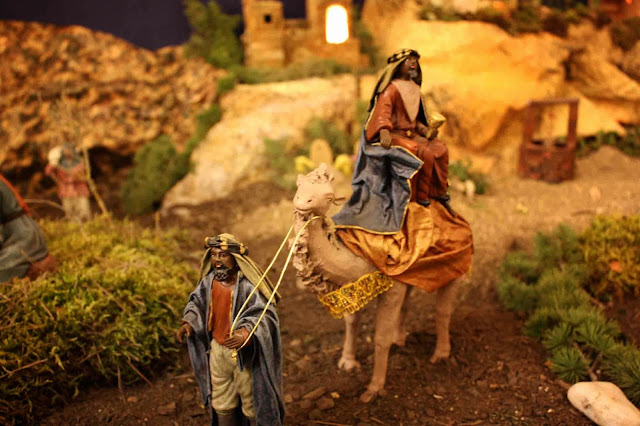
The Bethlehem scene consists of small figures
and models of what Bethlehem may have looked like at the time of the birth of Jesus. You will find Jesus (Jesús), Mary (María), Joseph (José), the Three Kings (los
Reyes Magos), shepherds (pastores), sheep (ovejas), mules (mulas), oxen (bueyes),
the stable (el establo), some houses and
shops like a bakery (panadería), or a butcher’s (carnicería), hills and maybe even a river.






Belén
What they do put up all over Spain in public spaces, churches and in some homes is a Belén, which is a scene of Bethlehem.
 |
| Bethlehem scene in the church of Cúllar, Granada |
Here are
some photos of a Bethlehem scene put together in the church of the village in Granada where I spent Christmas this year.
I think it’s really cute and they have gone into a lot of detail.


 |
| This is the Holy family which is why they have golden halos over their heads... Jesus is a few years old here. |

Children usually get involved in the decorating of their Belén or Nacimiento in the preparations of Christmas time. The models can be bought ready made and painted or plaster of Paris moulds of the figures can be painted at home. You can find most elements in craft shops, and then you just get creative.
Nacimiento
The part of
the Belén consisting of the stable with the baby Jesús, Mary and Joseph is called
the Nacimiento (birth) or the Milagro (miracle). If at home they don't put an elaborate Belén, they at least construct a Nativity scene to respect the festivity.
Here is the Nativity scene in the same Belén as in the photos above. You will note that the baby Jesus is not in the crib - this is because I took these photos before Christmas Day, i.e. before Jesus had been born.


Belén in Alicante
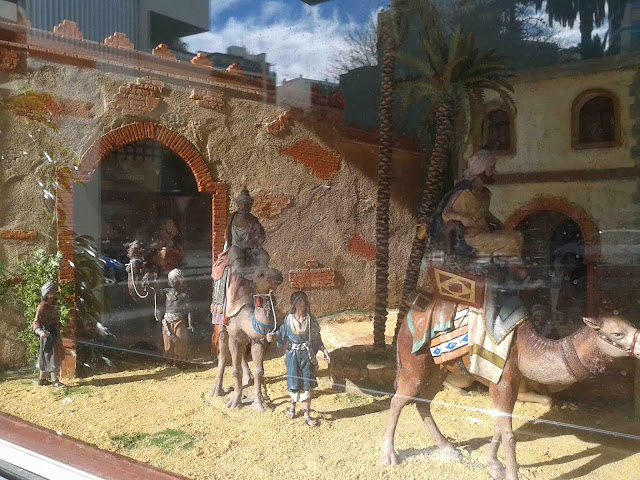
In the Plaza de la Montañeta in Alicante, they make a hut with a Belén inside divided into 4 specific scenes - like the Birth of Jesus and Three Wise Men following the star. (As the hut is outside and the models are in a glass case there is a lot of reflection in the photos. Sorry. I hope you can still see the models.)


How do you decorate your home or town at Christmas?
Subscribe to:
Posts (Atom)